
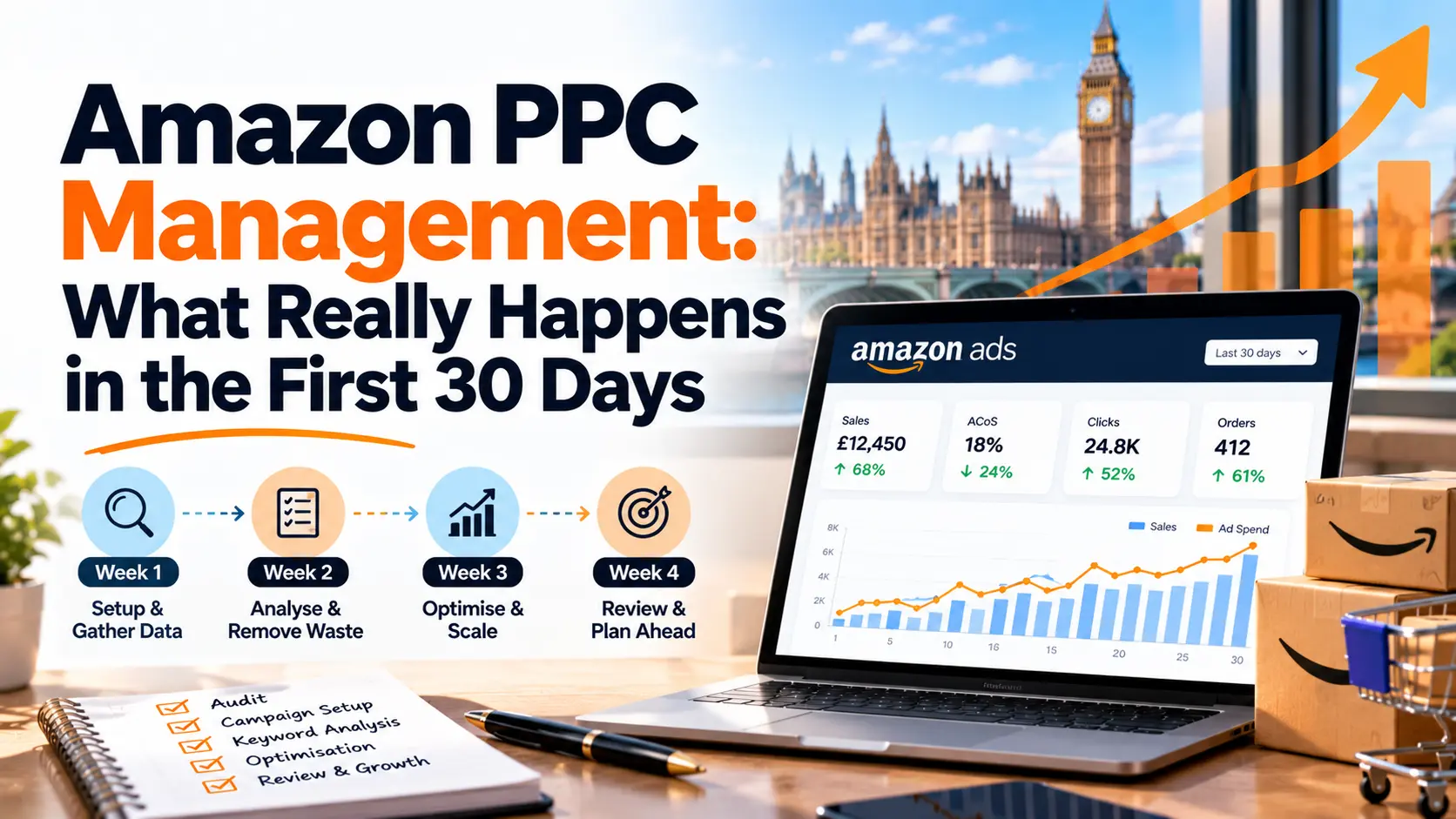

Most sellers expect Amazon ads to work like a tap: switch them on and sales pour out. Then the first week arrives, the report shows plenty of clicks, very few sales, and panic sets in. The truth is that the first month is often a learning period. Good Amazon PPC management is less about getting perfect results on day one and more about collecting useful information quickly.
This guide walks through the first 30 days, one week at a time, so you know what should be happening and when to worry. Whether you manage Amazon PPC yourself or hire an agency, the same principles apply.
Before Week One: Get the Ground Ready
Ads cannot fix a weak product page, so check these essentials first:
- Your listing: A clear title, quality photos and informative bullet points.
- Your stock: Enough inventory to support expected demand.
- Your price: Competitive pricing that still leaves a profit after fees.
- Your break-even number: The highest ACoS you can sustain without losing money on advertised sales.
If any of these are weak, address them before increasing advertising spend. Paying for clicks to a poor listing is like pouring water into a leaking bucket.
Professional Amazon product listing services can help improve product content before you invest heavily in advertising.
Week One: Switch On and Listen
The goal of the first week is not necessarily profit. It is to start gathering useful data.
What to set up:
- An automatic Sponsored Products campaign to discover relevant customer searches.
- A manageable daily budget that fits your available advertising funds.
- Sensible starting bids based on Amazon’s suggestions, competition and your margins.
What to check:
- Which search terms are generating impressions and clicks.
- Whether your advertisements are receiving enough visibility.
- Whether your spending is staying within the planned budget.
What not to do: Avoid changing bids every few hours. Frequent adjustments make it difficult to understand which decisions are affecting performance.
By the end of week one, you may have an initial list of search terms. Some could be surprising, and that information is valuable.
Week Two: Sort the Good From the Waste
Now you can start examining the available campaign data. This is where professional Amazon PPC services UK support can become useful.
Do these things:
- Open the search term report and review what customers actually searched for.
- Identify relevant terms that generated sales.
- Examine terms receiving clicks without conversions.
- Add clearly irrelevant searches as negative keywords.
For example, if you sell stainless steel water bottles but your advertisement appears for “plastic water bottle”, those clicks may not be relevant. A suitable negative keyword can prevent similar unwanted traffic.
Be patient with small numbers. Three clicks without a sale do not automatically mean a keyword is performing badly. Consider your expected conversion rate, spending and search relevance before making decisions.
Week Three: Add Control
By now, your automatic campaign may have revealed useful search terms. It is time to introduce more control where the data supports it.
Set up a manual campaign:
- Add promising search terms as keywords in a manual campaign.
- Use exact match for closely targeted searches.
- Consider higher bids for terms showing profitable performance.
- Keep automatic targeting active where it continues discovering useful opportunities.
Review placements and product targeting. Sponsored Products ads can appear in search results and on product pages. Placement reports help you understand which locations generate better results.
For example, top-of-search placements may cost more but could also convert better.
Check ACoS against your break-even target. If a campaign performs profitably, you may have room to increase investment. If spending exceeds your target, investigate the causes before making major changes.
An experienced Amazon PPC advertising agency in the UK can help review bids, targeting and campaign performance as more data becomes available.
Week Four: Review, Trim and Plan
The final week is an opportunity to review overall performance and prepare for the next month.
Questions to ask:
- Did total sales increase, or only advertising-attributed sales?
- Is ACoS moving towards the target?
- Which products benefited most from advertising?
- Are customers leaving reviews and providing useful feedback?
- Did inventory shortages affect performance?
Actions to take:
- Pause or reduce spending on consistently unprofitable keywords when sufficient data supports the decision.
- Consider increasing budgets for profitable campaigns limited by daily spending.
- Explore other eligible ad formats if your Sponsored Products campaigns are performing well.
- Record what worked and what needs improvement.
The goal is to finish the month with a clearer understanding of your advertising performance and priorities.
What the First Month Will Not Give You
It helps to keep expectations realistic.
- A perfect ACoS: Many campaigns require additional testing and optimisation.
- Instant organic rankings: Advertising can support visibility, but organic ranking depends on multiple factors.
- A set-and-forget campaign: Search behaviour, competitors and product demand continue changing.
If someone guarantees specific sales results within 30 days, be cautious.
A good advertising plan should focus on learning, measured decisions and ongoing improvements.
Signs Something Is Wrong
Not every slow start is normal. Investigate these warning signs:
- Many clicks and no sales: Review listing quality, pricing, search relevance and customer reviews.
- Almost no impressions: Bids, eligibility, targeting or campaign settings may need attention.
- Budget exhausted early: Your daily budget, bids or keyword targeting may require adjustment.
- Advertising sales without wider growth: Review whether paid campaigns are contributing to overall business performance.
Identifying these problems early can help prevent unnecessary spending.
When to Hand It to Someone Else
Many sellers successfully manage Amazon advertising themselves, and the first month can be a useful learning experience.
However, the work continues after the initial 30 days. Search terms need reviewing, bids require monitoring and advertising costs must be compared with product profitability.
Professional support may make sense when you have several products, limited time or difficulty interpreting campaign performance.
Before hiring an agency, ask how it approaches the first month, how often it reviews search terms and how advertising targets are calculated.
A team that can explain these decisions clearly is better positioned to manage your Amazon PPC campaigns responsibly.
How Creative Circuit Handles the First 30 Days
At Creative Circuit, our approach focuses on practical improvements and clear communication.
- Week one: Review listings, advertising readiness and product margins to establish initial targets.
- Weeks two and three: Analyse search terms, identify wasted spending and introduce more controlled targeting where appropriate.
- Week four: Review campaign performance and outline priorities for the following month.
Our focus is on helping sellers understand where their advertising budget goes and how campaign decisions support business goals.
Final Thoughts
The first month of Amazon advertising is about learning, not expecting instant results.
Start with a strong listing, gather useful search data, improve targeting and review performance against your profit margins.
Avoid making decisions based on a handful of clicks, and give campaigns enough time to produce meaningful information.
If you would like experienced support during those first weeks, explore Creative Circuit’s Amazon advertising and management services to understand how professional campaign planning and ongoing optimisation can support your business.
Start carefully, follow the data and improve your Amazon PPC strategy one week at a time.