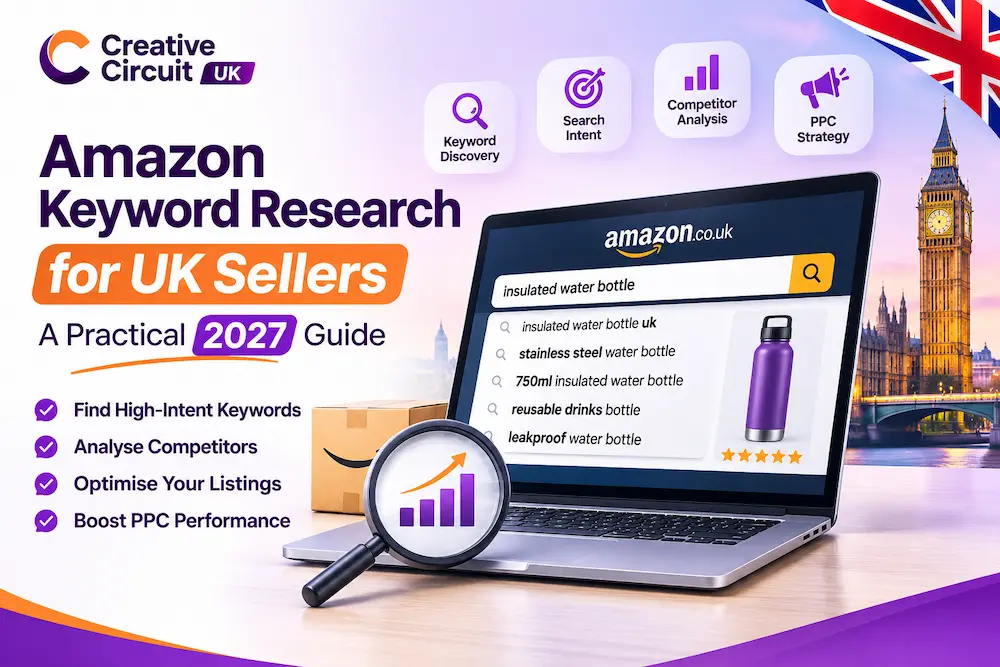
Amazon keyword research is the process of finding the words and phrases shoppers use when searching for products on Amazon. For UK sellers, effective keyword research means identifying relevant search terms, understanding buying intent and placing those terms strategically in product listings and advertising campaigns.
A keyword with high estimated search volume is not automatically valuable. The right keyword should accurately describe your product and attract shoppers who are likely to purchase it.
This guide explains how to research Amazon keywords, evaluate opportunities and improve product discoverability on Amazon.co.uk.
Why Is Amazon Keyword Research Important?
Amazon customers often search with a specific purchase in mind.
Someone searching for “water bottle” may be browsing, while someone searching for “750ml stainless steel insulated water bottle” has a more defined requirement.
Effective Amazon SEO starts with understanding this difference.
Relevant keywords can help sellers:
- Improve product discoverability in Amazon search.
- Align listing content with customer expectations.
- Identify long-tail purchasing opportunities.
- Develop more focused Amazon PPC campaigns.
- Discover gaps in existing product listings.
However, keyword optimization alone cannot guarantee higher rankings or sales. Pricing, product relevance, availability and customer experience also matter.
How to Do Amazon Keyword Research Step by Step
Step 1: Start With Your Product’s Core Features
Write down what the product is, who uses it and why someone would buy it.
For example, consider a stainless steel insulated water bottle.
Potential seed keywords include:
- Insulated water bottle
- Stainless steel water bottle
- Reusable drinks bottle
- Leakproof water bottle
- Water bottle for commuting
These are illustrative keyword ideas, not verified search-volume results.
Step 2: Research Amazon UK Search Suggestions
Visit Amazon.co.uk and type a seed keyword into the search bar.
Observe relevant autocomplete suggestions and note phrases that accurately match your product.
Repeat the process with product features, sizes, materials and intended uses.
UK sellers should pay attention to local vocabulary. British shoppers may use “drinks bottle” alongside “water bottle”, for example.
Avoid assuming that keyword popularity in the US is identical to demand in the UK.
Step 3: Analyse Competing Product Listings
Examine relevant products appearing for your target search terms.
Review their titles, product features, categories and positioning.
Look for useful descriptions of materials, sizes, intended uses and customer needs.
Do not copy competitor descriptions or include unrelated brand names in your backend keywords.
The objective is to understand how products are described and where your listing can provide clearer information.
Step 4: Evaluate Keywords by Search Intent
Not every keyword deserves equal attention.
| Keyword type | Example | Recommended use |
|---|---|---|
| Broad | Water bottle | Category relevance |
| Feature-specific | Insulated water bottle | Product title |
| Long-tail | 750ml insulated water bottle | Title or bullet points |
| Use-based | Water bottle for commuting | Relevant listing copy |
| Alternative wording | Reusable drinks bottle | Listing or backend terms |
Choose keywords based on relevance first, followed by available evidence of demand, competition and conversion potential.
Best Amazon Keyword Research Tools for UK Sellers
Several tools can help sellers discover and evaluate potential search terms.
| Tool | Primary benefit |
|---|---|
| Amazon Autocomplete | Discover search suggestions |
| Amazon Product Opportunity Explorer | Explore customer demand and product opportunities |
| Helium 10 | Third-party keyword and competitor research |
| SellerSprite | Keyword discovery and marketplace analysis |
| Amazon Ads Search Term Reports | Review searches associated with advertising clicks |
Third-party keyword volume figures are estimates and should not be treated as exact Amazon search counts.
Tool features, subscriptions and marketplace coverage should be verified before purchase.
Where Should You Place Amazon SEO Keywords?
Once you have selected relevant terms, distribute them naturally across the listing.
Product title
Include the product’s main identifying terms and important features while following the applicable category requirements.
Bullet points and product description
Explain benefits, materials, compatibility and intended uses in clear customer-focused language.
Avoid repeating the same phrase unnaturally.
Backend search terms
Use relevant synonyms and alternative expressions that are not already adequately represented.
Amazon UK’s guidance specifies a Generic Keyword attribute limit of less than 250 bytes and warns against prohibited or misleading terms.
Check the current category and marketplace rules before making changes.
For businesses requiring ongoing listing improvements, explore Creative Circuit’s Amazon SEO services.
How Does Keyword Research Improve Amazon PPC?
Amazon PPC keyword research uses advertising data to identify which customer searches attract clicks and sales.
For example, a seller may initially target “insulated water bottle” and later discover that a more specific phrase produces stronger conversion performance.
That phrase may deserve a dedicated manual campaign or a more prominent place in the listing, provided it accurately describes the product.
Review search-term reports, advertising costs, attributed sales and conversion rates before making decisions.
An experienced Amazon PPC management team can help connect keyword selection with campaign performance and profitability.
A Practical Amazon Keyword Prioritization Framework
Before adding a keyword, ask four questions:
- Relevance: Does the product genuinely match the search?
- Intent: Is the shopper likely to want this type of product?
- Evidence: Do available tools or reports support the opportunity?
- Commercial value: Could the keyword generate profitable sales?
Prioritize highly relevant keywords supported by actual marketplace or advertising data.
Review performance regularly rather than treating keyword research as a one-time task.
Frequently Asked Questions
What is the best way to find Amazon keywords?
Start with product attributes and Amazon autocomplete, then validate opportunities using relevant keyword tools and advertising search-term reports.
Is Amazon SEO different from Google SEO?
Yes. Amazon SEO focuses on product discoverability within a shopping marketplace, while Google SEO covers a wider range of informational, navigational and commercial searches.
Are long-tail keywords useful on Amazon UK?
Yes. Specific phrases can closely match shoppers’ requirements, although their actual demand and conversion performance should be verified.
How often should Amazon sellers update keywords?
Review keywords when product performance changes, new customer search data becomes available or the listing requires an update. Avoid unnecessary edits to well-performing listings.
Can Amazon keyword research improve PPC performance?
It can help identify relevant targets and reduce wasted spend when combined with search-term analysis, appropriate negative targeting and ongoing campaign optimization.
Final Thoughts
Successful Amazon keyword research in the UK is not about inserting the maximum number of search terms into a product listing.
It is about identifying customer intent, choosing relevant phrases, creating accurate product content and measuring results.
For brands seeking professional Amazon marketplace support, Creative Circuit UK provides Amazon marketing and growth services.
Ready to improve your Amazon UK product visibility? Contact Creative Circuit to discuss keyword research, listing optimization and advertising requirements.